
Measuring Homes: ANSI Standards Matter

Measuring Homes: ANSI Standards Matter

One of the biggest sources of confusion between agents and appraisers is how a home is measured. Since 2022, Fannie Mae requires appraisers to follow ANSI standards for measuring and reporting Gross Living Area (GLA).

The key point: only fully above-grade finished space counts as GLA.

This means a basement, even if fully finished, is not added to the total GLA. It’s reported separately. A 2,000 sqft home with a 1,000 sqft finished basement is not treated as a 3,000 sqft home in the appraisal. Basement space still has contributory value, but usually at a lower rate per square foot.

This is why MLS data and county records often conflict with appraisal reports especially in split-levels with garden levels. If MLS shows 3,000 sqft by including basement space, but ANSI requires 2,000 sqft GLA with 1,000 sqft basement, that difference can frustrate buyers and agents.

My advice: always clarify to clients how square footage is being reported to avoid surprises.
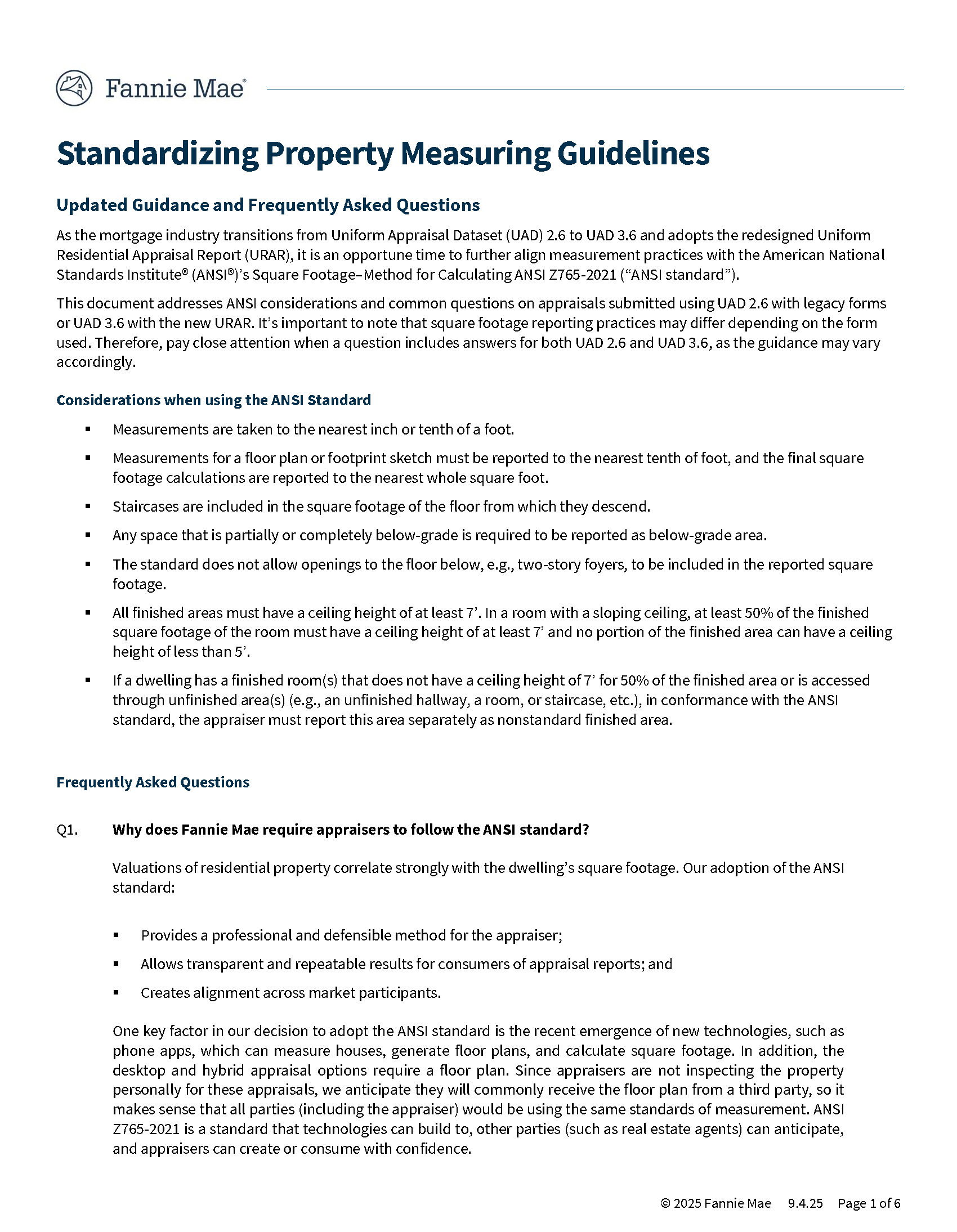
Standardizing Property Measuring Guidelines
Updated Guidance and Frequently Asked Questions
As the mortgage industry transitions from Uniform Appraisal Dataset (UAD) 2.6 to UAD 3.6 and adopts the redesigned Uniform Residential Appraisal Report (URAR), it is an opportune time to further align measurement practices with the American National Standards Institute® (ANSI®)’s Square Footage–Method for Calculating ANSI Z765-2021 (“ANSI standard”).
This document addresses ANSI considerations and common questions on appraisals submitted using UAD 2.6 with legacy forms or UAD 3.6 with the new URAR. It’s important to note that square footage reporting practices may differ depending on the form used. Therefore, pay close attention when a question includes answers for both UAD 2.6 and UAD 3.6, as the guidance may vary accordingly.
Considerations when using the ANSI Standard
▪
Measurements are taken to the nearest inch or tenth of a foot.
▪
Measurements for a floor plan or footprint sketch must be reported to the nearest tenth of foot, and the final square footage calculations are reported to the nearest whole square foot.
▪
Staircases are included in the square footage of the floor from which they descend.
▪
Any space that is partially or completely below-grade is required to be reported as below-grade area.
▪
The standard does not allow openings to the floor below, e.g., two-story foyers, to be included in the reported square footage.
▪
All finished areas must have a ceiling height of at least 7’. In a room with a sloping ceiling, at least 50% of the finished square footage of the room must have a ceiling height of at least 7’ and no portion of the finished area can have a ceiling height of less than 5’.
▪
If a dwelling has a finished room(s) that does not have a ceiling height of 7’ for 50% of the finished area or is accessed through unfinished area(s) (e.g., an unfinished hallway, a room, or staircase, etc.), in conformance with the ANSI standard, the appraiser must report this area separately as nonstandard finished area.
Frequently Asked Questions
Q1.
Why does Fannie Mae require appraisers to follow the ANSI standard?
Valuations of residential property correlate strongly with the dwelling’s square footage. Our adoption of the ANSI standard:
▪
Provides a professional and defensible method for the appraiser;
▪
Allows transparent and repeatable results for consumers of appraisal reports; and
▪
Creates alignment across market participants.
One key factor in our decision to adopt the ANSI standard is the recent emergence of new technologies, such as phone apps, which can measure houses, generate floor plans, and calculate square footage. In addition, the desktop and hybrid appraisal options require a floor plan. Since appraisers are not inspecting the property personally for these appraisals, we anticipate they will commonly receive the floor plan from a third party, so it makes sense that all parties (including the appraiser) would be using the same standards of measurement. ANSI Z765-2021 is a standard that technologies can build to, other parties (such as real estate agents) can anticipate, and appraisers can create or consume with confidence.
Q2.
When does ANSI apply?
ANSI applies to the measurement and reporting of above- and below-grade square footages for attached and detached single-family dwellings, including townhomes, rowhouses, manufactured homes, and detached dwellings. This is applicable to all hybrid appraisals and appraisals requiring interior and exterior inspections. If state law or a regulatory requirement mandates adherence to a different measurement standard the appraisal must note the standard required and explain how it was applied. The ANSI standard cannot be used to measure apartment/multifamily buildings.
Q3.
Is the ANSI standard required for manufactured housing?
Yes. The ANSI standard applies to all detached single-family homes, including manufactured housing.
Q4.
Does Fannie Mae require condominiums to be measured per the ANSI standard?
The ANSI standard should not be used if the architectural design is an apartment or multifamily building. When measuring a condominium or co-op that is part of an apartment or multifamily building, Fannie Mae’s policy of using interior perimeter measurements for the subject property should be applied. Irrespective of ownership type (condominium, co-op, fee simple, etc.), the ANSI standard must be followed for houses with detached or attached architectural designs including townhouses, rowhouses, and other side-by side houses.
Q5.
Is the ANSI standard required for 2- to 4-unit apartment/multifamily buildings?
No. The ANSI standard cannot be used for apartment/multifamily buildings. However, if each unit is a standalone structure or attached side-by-side, then the ANSI standard must be applied.
Q6.
Is the ANSI standard required for desktop appraisals?
No. The standard is not required for desktop appraisals. We encourage appraisers to voluntarily follow the standard on desktop appraisal assignments when feasible.
Q7.
Is the ANSI standard required for outbuildings?
No. The standard is not generally required for outbuildings. A separate software-generated footprint sketch that includes legible exterior wall dimensions must be provided for each additional structure with room labels, if applicable. Note: The ANSI standard must be followed for all accessory dwelling units.
Q8.
Do appraisers need to use software to comply with the requirement for sketches to be computer generated?
Yes. Appraisers must provide computer-generated (not hand drawn) sketches in their reports. Software that generates computer-based floor plans and footprint sketches for appraisal reports is widely available and commonly used by appraisers.
Q9.
When common practice in the local market differs from the ANSI standard, can the appraiser modify the subject’s square footages to conform to local custom?
No. The appraiser must measure and report the subject’s square footage(s) following the ANSI standard.
Q10.
Can appraisers voluntarily opt out of compliance with the ANSI standard?
No.
Q11.
Is there an exception process?
No. The “GXX001-” exception code has been retired. Fannie Mae policy now requires full compliance with the ANSI standard, including the necessary ANSI declarations to explain any limitations encountered during measurement. These declarations must be included in situations where the interior space is not inspected, measurements are based on building plans, or direct measurement of the dwelling is not possible. It’s important to note that while full ANSI compliance is required, our policy continues to permit—and require—an explanation when a different measurement standard is used due to state law or regulatory mandates.
Q12.
What should the appraiser do if compliance with the ANSI standard is not possible?
The appraiser should cite the state law or regulatory requirements that prohibits compliance with the ANSI standard and explain the alternative measurement standard that was used. It’s important to clarify that the use of one of the three prescribed ANSI declarations maintains adherence to the ANSI standard.
Q13.
The standard mentions a “statement of finished sq ft”; does Fannie Mae require appraisal reports to make an affirmative statement that the standard was followed?
No. Fannie Mae does not require an affirmative statement that the standard was followed.
Q14.
How can lenders validate the appraiser used the ANSI standard?
First, lenders should include a reminder to follow the ANSI standard in their assignment engagement letter or instructions to appraisers. As with all Selling Guide policies, lenders are responsible for verifying compliance prior to the sale of the loan to Fannie Mae. Lenders should familiarize themselves with the ANSI standard and adopt underwriting and quality control procedures to ensure that appraisal data, including square footage, is accurately reported. Lenders should verify that the sketch or floor plan exhibit in the appraisal report is consistent with the ANSI standard. For example, does it contain exterior dimensions measured to the nearest tenth of a foot? Does it show the required calculations? The lender should also cross-check the sketch or floor plan against the photo exhibits. For example, does it separate out unfinished areas, below-grade areas, and areas that do not meet ceiling height requirements? Do the contours of the walls match the visual evidence in the photos?
Q15.
Fannie Mae requires any area that is partially or wholly below-grade to be counted as below-grade square footage; what defines ‘partially’ below-grade?
A floor level is partially or wholly below-grade if any portion of its walls is not entirely at or above ground level.
Q16.
The ANSI standard specifically notes that the definition of above- and below-grade could cause some houses to have no above-grade finished square footage. How should appraisers report the lack of above-grade finished area, and room counts in this scenario?
UAD 2.6: Properties for which the entire square footage is below-grade (such as berm homes) would be described as having zero (0) sq. ft. of finished above-grade area and zero (0) rooms in the above-grade room counts. In this scenario, all finished area, nonstandard finished area and unfinished area would be reported as below-grade square footage(s).
UAD 3.6: All square footage would be reported as finished below-grade, finished below-grade (nonstandard), and/or unfinished below-grade area. The bedrooms and bathroom counts are reported as part of the total bedrooms, total bathrooms - full and total bathrooms – half. In addition, a room summary is provided in the Level and Room Detail table.
Q17.
How should appraisers account for rooms located in above-grade finished areas that do not meet ANSI standard minimums?
UAD 2.6: Appraisers should include rooms located in finished above-grade (nonstandard) areas in the room counts (Total Rooms, Bedrooms, Bath(s)) in the Improvement section and in the Sales Comparison Approach grid of the appraisal report to comply with Uniform Appraisal Dataset requirements.
Note: Noncontinuous finished area is reported separately in an additional row on the grid and should not be included in the finished above-grade area or room counts. See Q18.
UAD 3.6: Appraisers should include rooms located in finished above-grade (nonstandard) areas in the total bedrooms, total bathrooms – full, and total bathrooms – half located in the Unit Interior section of the URAR. In addition, each room should be identified in the Level and Room Detail table in the Room Summary.
Note: Noncontinuous finished area is reported separately in the Dwelling Exterior section of the URAR and should not be included in the Unit Interior areas or room counts. See Q18
Q18.
How is noncontinuous finished area different from nonstandard finished area?
The primary difference is whether there is direct interior access to the finished area. Noncontinuous finished area is any above-grade finished area(s), not designated as an accessory dwelling unit (ADU), attached to the dwelling with no direct interior access. Whereas nonstandard finished area is finished area(s) with direct interior access from within the dwelling not conforming to the ANSI ceiling height requirements or accessed through unfinished area(s) (e.g., an unfinished hallway, a room, or staircase, etc.). UAD 2.6: Noncontinuous area must be reported on a different line in the adjustment grid and not included as part of the subject's reported finished area(s), nonstandard finished area(s), or room counts. If there are multiple noncontinuous areas combine them into one entry in the Sales Comparison grid line.
UAD 3.6: Noncontinuous finished area is reported separately in the Dwelling Exterior section of the appraisal report and includes a separate room summary. If there are multiple noncontinuous finished areas in the dwelling, the square footage of these areas is combined. Nonstandard finished area is reported in the Unit Interior section of the URAR as either Finished Above-Grade (Nonstandard) or Finished Below-Grade (Nonstandard).
Q19.
When the ANSI standard excludes nonstandard and noncontinuous finished areas from the above- and below-grade finished areas, does this adversely affect the value of the property?
No. The standard defines a transparent, professional approach to describing the subject, which gives appraisers a consistent starting point for the valuation analysis, but it says nothing about how appraisers conduct that analysis. Done correctly, adherence to the standard does not change the value of the property.
Q20.
How should appraisers value finished areas that do not meet the ANSI standard?
Our longstanding policy on adjustment rates has not changed: we require appraisal adjustments to reflect market reaction. This is explained in the Analysis of Adjustments section of Selling Guide B4-1.3-09, Adjustments to Comparable Sales and the corresponding section SB4-1.3-09 in the UAD 3.6 Policy Supplement: “The expectation is for the appraiser to analyze the market for competitive properties and provide appropriate market-based adjustments...” It is up to the appraiser to determine the market reaction for nonstandard and noncontinuous finished areas, which may be greater than, less than, or equal to that of the finished areas.
Reminder: Fannie Mae does not have restrictions on gross, net, or line-item adjustments.
Q21.
Will appraiser adherence to the ANSI standard cause confusion when the subject square footage differs from other sources such as MLS or public record?
Square footage from appraisal reports is already often different from other sources. It is common practice to treat some finished areas separately from others due to low ceilings, inferior quality, below-grade walls, or separation from the main living area. Many factors such as variability in definitions, methodologies, or precision of execution can exacerbate differences. The benefit of adherence to the standard is that it enables appraisers to explain how above and below-grade areas are derived in consistent, professional terms. This will result in more clarity for consumers of appraisal reports. It will also enable lenders, real estate agents, and other participants in the transaction to better anticipate appraisal outcomes, which can help reduce loan closing issues.
Q22.
The square footages of comparables available to appraisers may not be based on the ANSI standard. How should appraisers manage this issue?
Square footage(s) found in local MLS systems and assessor records may not have been derived using the ANSI standard for measuring and calculating square footage. The appraiser may not know what methods real estate agents or assessors use to ascertain square footage. Appraisers already routinely deal with this uncertainty, regardless of what measuring, calculating, and reporting method the appraiser uses for the subject property. Through research and knowledge of the local market, appraisers determine if the square footage(s) of the comparable should be adjusted relative to the subject. Appraisers will continue to perform this analysis like they have always needed to do.
Q23.
What if comparable sales are measured differently?
Square footages for properties in local MLS systems and assessor records may not have been derived using the ANSI standard for measuring and calculating square footage. The appraiser may not know what method was used to calculate the square footage shown in an MLS listing or in tax assessor data. Through research and their knowledge of the local market, appraisers determine if the square footage provided through alternate sources should be adjusted. The adjustment process does not change the requirement to report subject square footage(s) using the ANSI standard.
Resources
Appraisers can visit Home Innovation Research Labs to obtain a copy of the ANSI standard.
UAD 2.6:
▪
Selling Guide B4-1.3-05, Improvements Section of the Appraisal Report and B4-1.2-01, Appraisal Report Forms and Exhibits
▪
Uniform Appraisal Dataset Specifications, Appendix D: Field Specific Standardization Requirements
UAD 3.6:
▪
UAD 3.6 Policy Supplement, SB4-1.3-05 Dwelling Exterior, Unit Interior, and Outbuilding Section of the Appraisal Report and SB4-1.2-01, Appraisal Reports and Exhibits
▪
Uniform Appraisal Dataset (UAD) Specification, Appendix F-1: URAR Reference Guide